

5 Creative Mirror Photography Ideas
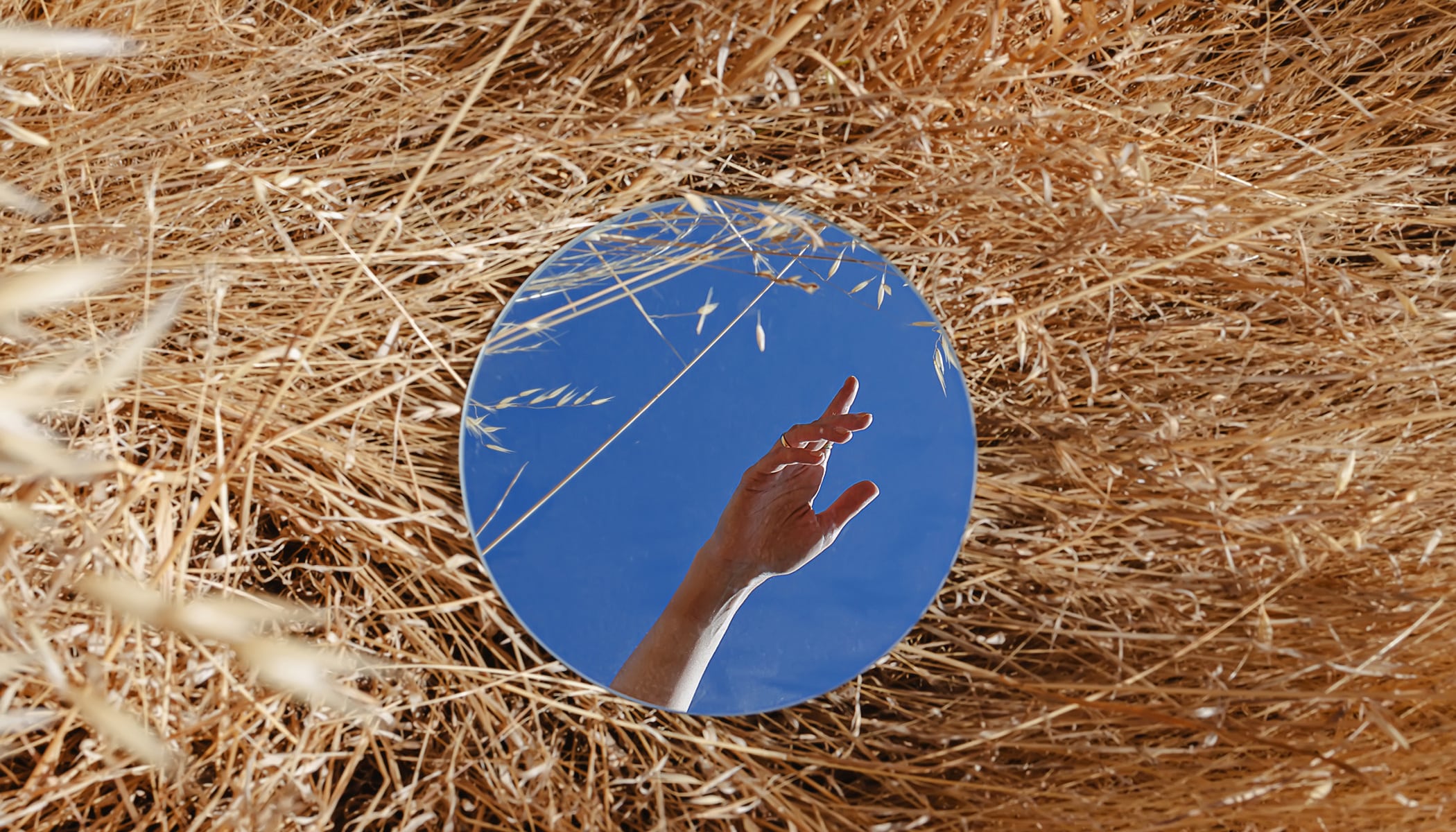
A mirror is an ordinary object everyone has at home. However, in photography, a mirror can become a surprisingly versatile prop. It can hide certain things, reveal something outside the frame, divide an image into several parts, or connect two completely different worlds.
For many of these ideas, all you need is a small round mirror, a large floor-length mirror, or several smaller mirrors. The key is to start thinking of reflections as another layer of the composition that you can work with.
In this article, you’ll learn:
- How to use a mirror to capture just a part of the face or body.
- How to use several mirrors to create your own photographic kaleidoscope.
- How to use a mirror as a compositional element in still lifes.
- How to use water on a mirror’s surface to create surreal, distorted reflections.
- How to use a mirror to connect two different subjects.
1. Body parts
A mirror doesn’t have to show the entire face or the whole figure. On the contrary, it can be much more interesting to capture just a fragment of your subject.
You can use a small mirror to frame an eye, part of the face, a hand, or another detail—all without any post-production. A mirror allows you to show several different perspectives at once and create a much more interesting portrait. At first glance, the viewer may not know exactly what is real and what is a reflection. It is precisely this uncertainty that makes the photograph so intriguing.

For example, try capturing one eye in the reflection, half a face, a hand that appears in another part of the photo, or the actual face alongside its fragmented reflection. You can also experiment with depth of field. One part of the face can be in focus, while the reflection remains soft and out of focus. This gives the photograph another layer.

TIP: I recommend checking out the work of Chinese photographer Ziqian Liu, who is a master of mirror photography.
2. Create a photographic kaleidoscope
One mirror reflects reality once. But several mirrors multiply the reflection. You can use this principle to create your own photographic kaleidoscope. One face appears multiple times, hands are repeated in different directions, and the individual reflections create a new geometric composition. By carefully arranging the subject, you can create a thoughtful image where the individual parts complement one another.
You can use several smaller mirrors or reflective surfaces positioned at different angles. It’s a good idea to attach them to a piece of sturdy paper or cardboard. Then it’s simply a matter of experimenting. Position the model so that their face or hands appear in the individual reflections, and gradually adjust the angle of the mirrors.

Symmetrical compositions, bold geometric shapes, and colorful clothing that repeats in the reflections work particularly well here. A kaleidoscope doesn’t necessarily mean cramming as many reflections as possible into the photo. What matters is that the resulting image has a sense of visual logic.
3. Mirrors in still lifes
A mirror can be an interesting addition to a still life. It can create the illusion of space, double an object, or make the viewer wonder where the real object ends and its reflection begins. You can use it as an additional surface that actively changes the very shape of the objects you photograph.
Add a mirror to a simple scene and start arranging different objects in front of it.

For example, try photographing only part of an object and let the rest appear in the reflection; connect the actual object with its reflection to create a new shape; or work with lines that extend from the real space into the mirror. In our photo, a simple organic object takes on a new shape thanks to the mirror. What would otherwise be just an object placed in the scene gains a new dimension.
TIP: Minimalism works particularly well with this type of photography. The mirror itself already adds additional information to the image. Add more objects only when you feel comfortable with still-life compositions.
4. Water on the mirror’s surface
A mirror can create a perfect reflection. But what happens when you disturb that reflection with water? I got the idea from the work of creative Spanish photographer Jordi Koalitik, and the results are fascinating. A thin layer of water, droplets, or gentle ripples can distort the reflection. This breaks up the face and makes the lines ripple, giving the photograph a dreamlike or even surreal atmosphere.
Place the mirror horizontally and pour a small amount of water onto its surface. Then experiment with different angles. Either move the mirror yourself, or ask the model to touch the water with her finger or let the water droplets fall onto the surface. Every moment will have slightly different results, so it’s worth taking multiple shots.

TIP: You can also try photographing only the reflection. The viewer might not immediately realize they’re looking at an image created on a mirror covered with water.
5. Portraits in landscapes
You can take a mirror outside and use it to bring a part of the landscape into the photo, even if it isn’t in front of the camera. This allows you to combine elements that aren’t physically next to each other.
Combining two different environments can work well. For example, place a mirror in the grass. Suddenly, a blue sky appears in it. The model can hold the mirror in her hands, on her lap, or in front of her face.

Or, try the opposite. If the landscape in front of and behind the model is similar, such as a forest or meadow, the model can hold the mirror in their hands that reflects the same greenery as the background. This creates the illusion that the mirror is transparent.
More tips in our video
Interested in mirror photography? Check out our video for more tips and creative ideas.
FAQs
How do you take a portrait with only part of the subject’s face reflected in a mirror?
All you need is a small round mirror in which you capture just part of the face—an eye or a hand—without any post-production. You can also create an interesting effect by keeping the reflection in the mirror out of focus while the actual face remains in focus.
How do you create a photographic kaleidoscope using mirrors?
Use several mirrors or other reflective surfaces positioned at different angles, ideally mounted on cardboard. Then position the model so that their face or hands appear in each reflection, and gradually adjust the angles until the composition comes together.
How can you use mirrors in still lifes?
A mirror in a still life can double an object, create the illusion of space, or merge the real object with its reflection to create a new shape. Keep the composition minimalist, since the mirror itself already adds visual information to the image.
How can you create a distorted reflection using water on a mirror?
Place the mirror horizontally and pour a thin layer of water onto its surface. Droplets or gentle ripples will blur and distort the reflection, giving the photograph a dreamlike or even surreal atmosphere.
How can you use mirrors to connect two different settings in a single photograph?
Place the mirror in one place, such as the grass, so that it reflects a completely different setting, such as the sky. Conversely, if the surroundings in front of and behind the model are similar, a reflection of the same colors or textures can create the illusion that the mirror is transparent.


There are no comments yet.