

Smartphone or Camera? When to Shoot with your Phone and When a Camera Is the Better Choice
Debates over megapixels and sensor size can easily overshadow what really matters. It’s the story, the emotions, and the light that make a great photo, not the technology. In this article, we’ll look at when it makes sense to use a smartphone and when a camera is the better choice. We’ll take into account how quickly you need to react, whether you want to remain inconspicuous in a crowd, how people around you respond, and what you plan to do with the photo. There is a comparison of the key settings of both options at the end.
In this article, you’ll learn:
- When a smartphone is faster and more practical than a camera.
- How using a camera can change the behavior of the people around you.
- Why a smartphone can serve as a “visual sketchbook,” even for professional photographers.
- What to consider when the weight of gear or air travel is a factor.
- How smartphones and cameras differ when it comes to sharing and printing photos.
Most photography discussions online sooner or later devolve into endless comparisons of megapixels, sensor sizes, and dynamic range. But in the heat of these technical debates, we often forget what ultimately resonates most with the viewer: the story, the emotion, and the light in a photo.
The question of what to shoot with shouldn’t distract us from what matters most in photography. Instead, the technology we choose should help us capture it better. We want our gear to be more than just a tool. It’s important to understand how our choice affects the way we work, how the people around us react, and ultimately, the feeling the resulting photo conveys.
When smartphones are faster than cameras
A smartphone is the perfect choice when something is happening right now. You can pull it out in a second and start shooting without any preparation. That makes it ideal for everyday situations that might be over before you could get a camera out of your bag. Sometimes, it’s better to have any photo rather than no photo at all—like for that time when the Loch Ness Monster suddenly appears in the lake.
A camera, on the other hand, gives you a reason to stop. The simple act of taking it out of your bag, removing the lens cap, and turning it on puts you in a different frame of mind. There’s more time between the impulse to take a photo and pressing the shutter button. A camera also requires decisions: Which lens should I use for this scene? What f-number and shutter speed should I choose?


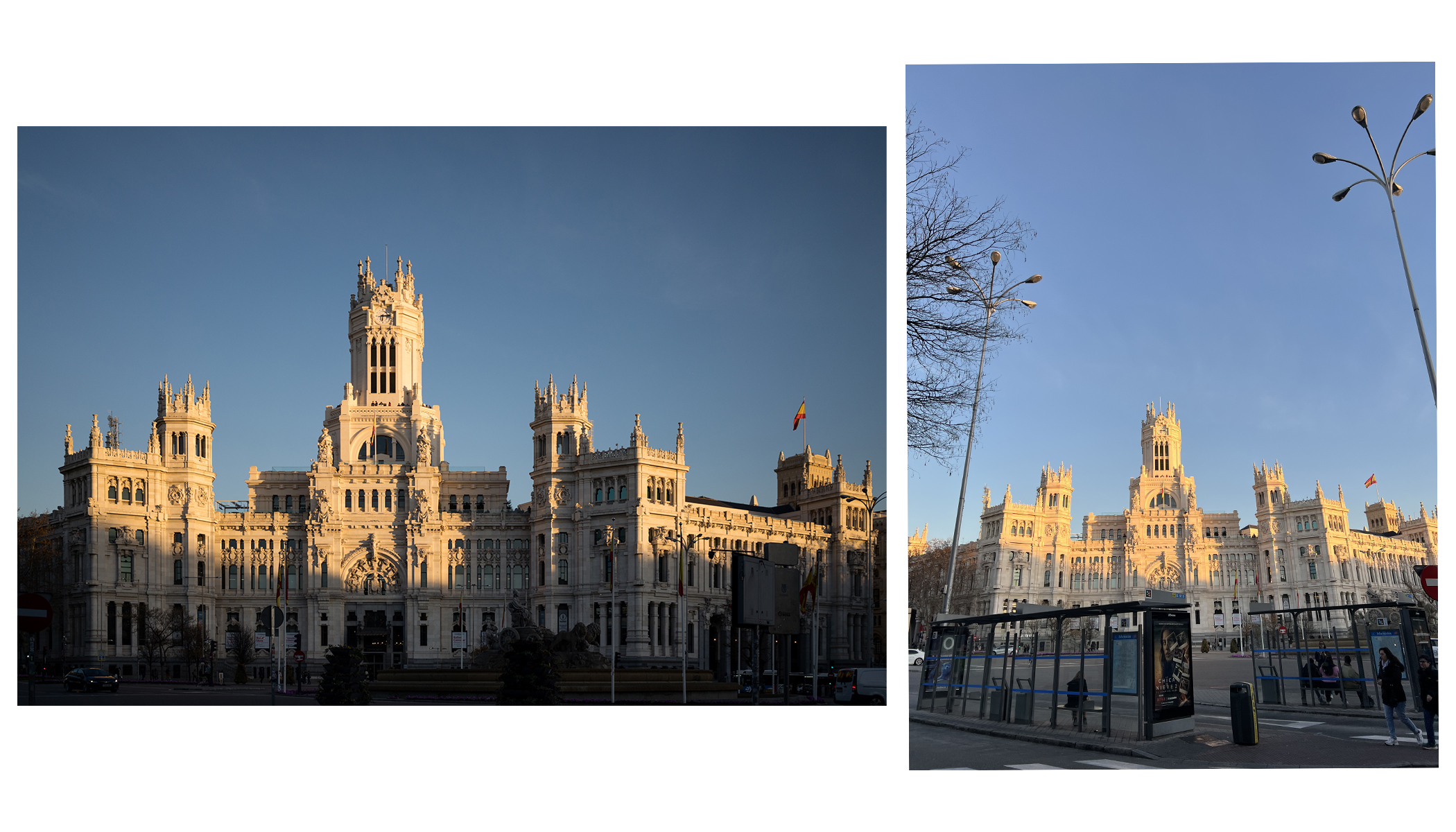
Even though these two photos are similar, I personally prefer the camera photos because of their finer details. If you’re viewing the photo on a phone, you might not notice much of a difference.


For comparison, we’ve included a crop that shows the loss of detail. Shot on a Samsung Galaxy S23 (left) and Sony A7 III with a 28-70mm lens (right). © Ester Dobiášová
Neither approach is inherently better than the other. You can consciously think through your scene and make manual adjustments to the image even with a smartphone. You can also carry your camera at your waist, have it turned on, or keep it in your hand so you can react immediately.
How your gear changes the behavior of those around you
As photographers, we’re never alone in a space. The device you’re holding can change how the people around you react. With a smartphone in your hand, you might look like a tourist, a passerby, or just someone checking a map, looking something up online, or even touching up their makeup. People tend to ignore you. That’s a huge advantage for street photography or candid shots. People behave more naturally, and they’re less likely to react to the camera.

As soon as you raise a body and lens to your eye, you’re signaling: “I’m taking a picture.” People notice, often sit up a little straighter, and start behaving differently. Some smile, some adjust their posture, and others pull away.
That doesn’t necessarily have to be a bad thing. In situations where people expect to be photographed—like at weddings or portrait sessions— a camera can give the situation a sense of formality and makes the subject feel important. Once again, it depends on your intention.
A smartphone as a visual sketchbook for photographers
For many professional photographers, a smartphone has become an indispensable “visual sketchbook.” You can use your phone to experiment with an unconventional angle, see how shadows fall in a particular location, or simply mark a spot for a future photo shoot.
You can also carry a cheaper compact camera for similar purposes, but a smartphone is more versatile—you can’t make a phone call with a camera. On the other hand, that might actually be an advantage. A camera disconnects you from the constant stream of notifications, emails, and social media that are always just a swipe away on your phone and can distract you from the scene in front of you.


When shooting with a high-zoom lens, I can zoom in much farther without losing quality. Both photos were taken from the same spot. The drop in quality is much more noticeable on the smartphone. Taken with a Samsung Galaxy S23 (left) and Sony A7 III with a 28-70mm lens (right). © Ester Dobiášová
When weight matters
Whether you’re heading out for an all-day hike in rugged terrain or going on a family outing where your primary role is being a parent, carrying a bag full of gear can be a burden. In situations like these, a smartphone gives you greater freedom of movement without adding extra weight. The same applies when you’re traveling by air and want to keep your luggage as light as possible.
If you’re constantly struggling to balance between weight and image quality, there is a happy medium: an advanced compact camera. Cameras such as the Sony RX100 or the Ricoh GR may require a bigger investment, but they offer a larger sensor in a body small enough to fit in your jacket pocket.


Shot on an iPhone 13 Pro and Sony a7c + 35 mm. © Jan Prokopius
Smartphone or camera for social media and printing
If you’re in a hurry, you can edit a photo from your phone using an app or the built-in editing tools and send it to your family in under a minute. You can take, edit, and publish photos using a single device, which is incredibly convenient. With a camera, there’s usually an extra step involved. Working with large files, especially RAW files, requires a computer or tablet to take full advantage of the sensor’s potential.
When viewing photos on a small phone screen, the differences between the two technologies are less noticeable. However, as soon as you enlarge a photo on a monitor or print it, you’re more likely to notice digital noise, smeared textures, and unnatural-looking background blur. A camera preserves optical depth and fidelity that no filter can fully replace.
Smartphones vs. cameras: Comparison at a glance
To help you make the right choice at a glance, here’s a comparison of some of the key features. Of course, the technical specifications matter too, but we’ll take a closer look at those in a separate article.
| Feature | Smartphone | Camera |
| Readiness and speed of use | ⭐⭐⭐⭐⭐ | ⭐⭐⭐ |
| Weight and compactness | ⭐⭐⭐⭐⭐ | ⭐⭐ |
| Discreetness | ⭐⭐⭐⭐⭐ | ⭐⭐ |
| Creative control (RAW, manual mode) | ⭐⭐ | ⭐⭐⭐⭐⭐ |
| Large-format printing | ⭐ | ⭐⭐⭐⭐⭐ |
Two paths, one goal
Smartphones and cameras develop different skills, and consciously choosing between them is a sign of a mature photographer—someone who understands that technology should serve their creative vision, not the other way around. As I mentioned in the introduction, ultimately, it’s about the story, the emotions, and the light.
FAQs
When is it better to take a photo with a smartphone instead of a camera?
A smartphone is perfect for quick, unexpected situations where you don’t have time to prepare. It’s also great for street photography, because, unlike a camera, it lets you blend into the crowd, so people are less likely to change their behavior around you.
Why do people react differently when they see a camera?
A raised camera and lens clearly signals that you’re taking a photo, so people start adjusting their posture or facial expressions. On the other hand, a smartphone looks like an ordinary part of everyday life, so people are more likely to behave naturally.
Is an advanced compact camera worth it as a compromise?
Yes, if you’re frustrated by the trade-off between the light weight of a smartphone and the image quality of a traditional camera. Models like the Sony RX100 or the Ricoh GR offer a larger sensor in a pocket-sized body, although they come with a higher price tag.
Why is the difference between a smartphone and camera only visible when zooming in or printing?
Differences in quality can be difficult to spot on a phone’s small screen. But when you zoom in on a monitor or print the image, you’re more likely to notice digital noise, smeared textures, and unnatural-looking background blur—issues that are generally less noticeable with a larger camera sensor.
Is a camera better suited for working with RAW files than a smartphone?
Yes. Working with RAW format requires a computer or tablet to make full use of the sensor’s potential, while a smartphone lets you edit and share photos directly from a single device.

There are no comments yet.