

Infrared Photography: How It Works and Getting Started
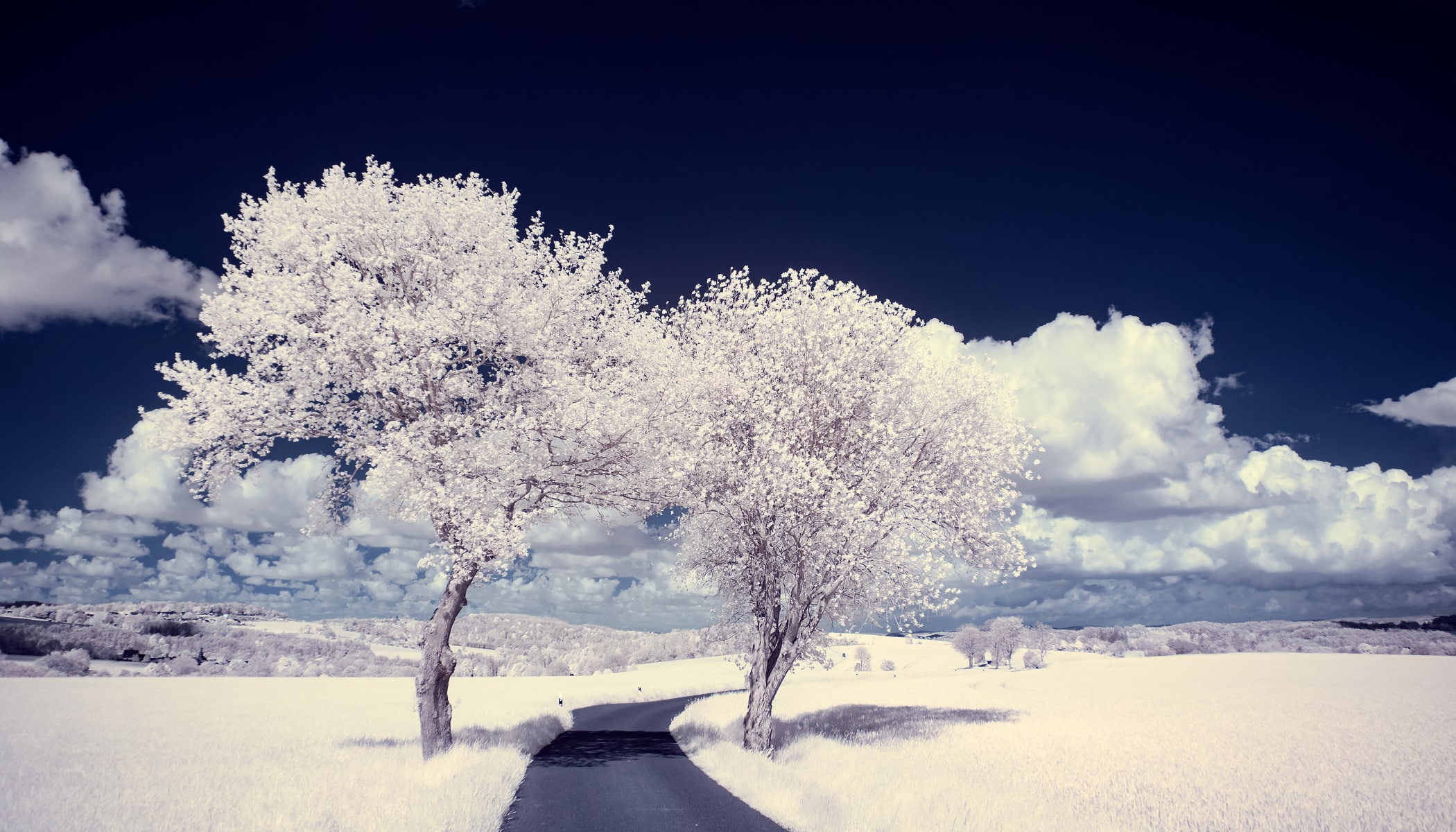
Infrared (IR) photography lets you capture light radiation that is invisible to the human eye. Find out how an infrared filter works, why grass looks white in IR photos, which filter to choose, and how to get started with infrared photography.
In this article, you learn:
- What infrared light is and how it differs from the visible spectrum.
- Why grass looks white and the sky looks black in IR images
- How IR filters and IR-cut filters in cameras work.
- Equipment options for getting started with IR photography.
Imagine a world where grass is as white as snow, the sky is dark, and human skin looks like it’s made of marble. This isn’t computer graphics or AI—it’s infrared light captured by a camera. In infrared photography, ordinary scenes transform into magical, dreamlike landscapes, revealing textures and colors invisible to the naked eye.
Infrared photography isn’t a new fad. It has long been used in scientific imaging, the military, and landscape documentation. Today, creative photographers are rediscovering it as a way to see the world around them differently. Suddenly, they are able to see familiar places from a completely new perspective.
What is infrared photography and how does IR light work?
Ordinary photographs captures visible light with wavelengths roughly between 400 and 700 nm. Just beyond this range lies infrared radiation (above 700 nm), which is invisible to the human eye. Digital sensors equipped with infrared (IR) filters can detect it, but cameras normally include an IR-cut filter to block it and ensure accurate colors in standard photos.
Why the grass is white and sky is black in IR photos
What makes IR photography fascinating is that it’s less about color and more about how different materials respond to infrared radiation. Vegetation—leaves, grass, bushes—reflect IR light very strongly, which is why it appears bright. On the other hand, water and the sky absorb much of it, so they appear dark.

Human skin allows IR light to penetrate deeper, reducing the visibility of small imperfections. As a result, skin can look very smooth, waxy, sometimes even lifeless, with veins becoming more pronounced.

The result is defined by contrast created by different materials’ responses to infrared radiation rather than by color itself. This is what makes IR photos so distinctive and convincing.

Why the sun is key in infrared photography
IR photography often evokes night-vision imagery, but it actually works best in bright sunlight—the stronger the sun, the better. Landscapes, architecture, and static scenes with ordinary objects work particularly well. Without greenery, IR images often lose their magic.

A dark lens filter extends the shutter speed, usually to 1/30 s or longer, making it harder to photograph children, animals, or street scenes. They’re best suited for calm, static scenes.

TIP: Not all lenses perform equally well with IR filters. Some wide-angle lenses might show vignetting, though it can sometimes add character.
How to do IR photography
Every digital camera has an IR-cut filter in front of the sensor that blocks infrared radiation. To shoot infrared, you need to work around this in one of three ways.
1. IR lens filter
The simplest method that requires no camera modification is using a dark red or black IR filter. The downside is very long exposures, often several seconds in sunlight, so a tripod is essential.
Even when shooting IR, the sensor still records color. The result depends on the filter wavelength. Filters between 590–720 nm allow color IR images with surreal, almost “painted” images. 830 nm and higher gradually lose color, leaving light, contrast, and texture—close to black and white, but with a distinctive look.
2. Permanent camera modification (IR conversion)
This involves converting an older camera you no longer use. The camera then becomes dedicated to infrared photography and can no longer take standard photos. Tech-savvy photographers can do it themselves, but don’t risk it and take your camera to a service center and ask them to remove the IR-cut filter from the sensor.

3. Older cameras with switchable IR filters
Some older models, such as the Sony DSC-F828 or Canon EOS 20 DA, allowed shooting IR without major modification. They have an electronic IR filter that you can easily turn off. Cameras like these are rare now, as modern designs prioritize accurate color rendering with permanent IR-cut filters.

See the world with infrared eyes
Infrared photography opens a window into a world we can’t normally see—and that’s where its power lies. It’s not just a technical experiment, but a way to reinterpret familiar landscapes, portraits, and architecture into images with a completely different atmosphere.
Whether you start with a simple IR lens filter or go all the way with a converted camera, you’ll gain images with striking contrast, dreamlike aesthetics, and a unique style. All you need is sunlight, patience, and the desire to see the world with new eyes.
FAQs
What is infrared photography? Infrared photography captures light at wavelengths above 700 nm, which is invisible to the human eye. This produces images with distinctive contrast between vegetation, sky, and water.
Why is grass white in infrared photos? Vegetation strongly reflects infrared radiation (the Wood effect), so it appears very bright or white.
Which filter should I use for infrared photography? The most common IR filters are 590 nm, 720 nm, and 830 nm. Lower values allow more color; higher values produce nearly black and white results.
Can I shoot IR without modifying my camera? Yes, by using an IR lens filter. However, expect the exposures to be long.
What is IR conversion? A permanent modification where the IR-cut filter is removed or replaced, turning the camera into a dedicated device for IR photography.
Is infrared suitable for portraits? Yes, but skin appears very smooth and eyes can look significantly darker. The effect can be creative, but also distracting.
Why is it best to take IR photos in bright sun? Infrared radiation is strongest in direct sunlight, producing the most pronounced contrast and dramatic effect.


There are no comments yet.