

Action, Landscapes, and Snow: Winter Mountain Photography
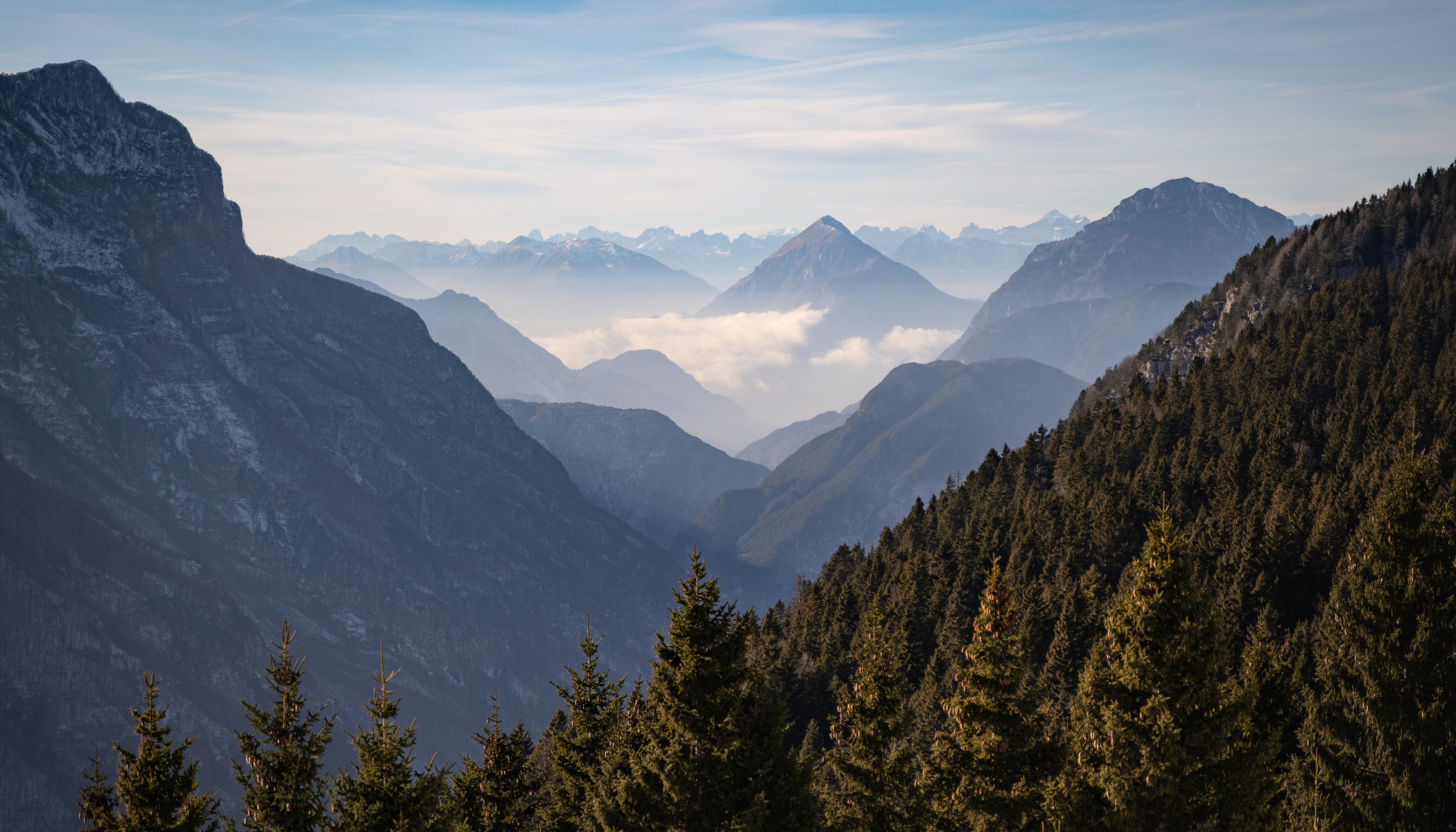
Winter mountains offer breathtaking landscapes, extreme contrasts, and fast-paced action on the slopes. In this article, you’ll find practical tips for exposing snow correctly, working with shutter speed when photographing skiers, and using proven composition techniques. You’ll also learn when to choose minimalist shots or black and white, how to set up your camera in changing mountain conditions, and how to put together a cohesive photo series.
In this article, we cover:
- How to creatively use fast and slow shutter speeds when photographing skiers.
- Why a straight horizon is key in mountain photography and how to use the rule of thirds and fifths for stronger composition.
- How to work with lines and triangle composition in mountain landscapes.
- How to expose snow correctly so it’s neither gray nor overexposed.
- When to choose a minimalist approach and when to opt for black and white.
- Why it’s better to think in terms of a series rather than chase a single shot.
Winter mountains can be both generous and challenging at the same time. They offer clean lines, dramatic light, and a powerful atmosphere—but also extreme contrasts and unpredictable conditions. The following tips can help you overcome these obstacles and make the most of the mountains’ potential.
Photographing skiers in action
Photographing skiers in action can add movement, energy, and scale to winter photos. Because activity on ski slopes tends to follow predictable paths, you often have enough time to experiment with different shutter speeds.
Fast shutter speeds (e.g., 1/1000s, depending on the light) are ideal for capturing the action and freezing motion: snow spraying into the air, a jump at its peak, or the split-second expression on a snowboarder’s face before a fall.

Slower shutter speeds (e.g., 1/30s or even 1/10s) blur the skier’s movement. To make it clear that the blur is intentional, include something sharp in the frame. This could be part of the landscape—a tree, a cable car pole, a rock, the edge of the slope, or the point where the skier passes through the scene.


To use a slower shutter speed, you need to adjust your settings accordingly. Set a higher f-number (for example, f/22) and keep your ISO as low as possible. Be aware that at very high f-numbers, even small specks of dust on your lens or sensor can become visible, which can mean extra work later in photo editing. Keeping your equipment clean pays off. f/22, 1/10s, ISO 100, 28mm © Ester Dobiášová
This approach is especially useful for longer exposures—unless you’re intentionally creating an abstract image, where large white areas and flashes of colorful jackets can work beautifully.
Mountain landscape composition
The basic rule in mountain photography is keep the horizon straight. A tilted horizon may add drama, but in landscapes it often creates tension and a feeling that the image is “falling.” Mountains symbolize stability and strength, and a diagonal composition can undermine that impression. Look for dynamics in movement, light, and natural lines instead of tilting the entire scene.

Rule of thirds and fifths:In open landscapes, the rule of thirds and fifths helps divide the image into clear sections. Placing the horizon, a ridge, or another dominant line off-center adds rhythm. In winter, when the landscape is visually simpler, this structure prevents the image from feeling flat.
Should the horizon sit higher or lower in the frame? Ask yourself: What is more important in this scene? If it’s the sky, give it more space. If it’s the terrain, foreground lines, or textures in the snow, let the landscape dominate.

Lines:Lines are a powerful compositional element—slopes, paths, sky lifts, and tracks in the snow naturally guide the viewer’s eye through the image. Ski tracks or hiking trails can connect the foreground with the distant peaks, giving the image depth.

Triangles: Triangle composition works particularly well in mountainous landscapes. This isn’t a strict rule, but a way of working with shapes that naturally occur in mountain scenery. You can seek out triangles deliberately, but they often appear on their own. Pay attention to the shapes of slopes and peaks in your viewfinder and let them assemble the image naturally.
A triangle composition often places the main subject near the base of an imaginary triangle, guiding the viewer’s eye upward or inward. The triangle can be formed by a dominant peak, a cluster of hills, or a combination of slope, road, and sky. The result feels balanced without being static.


The same location, three hours apart. © Ester Dobiášová
Camera settings for photographing the snow
Snow is one of the most challenging surfaces to expose correctly because the large white areas can confuse the camera’s light meter. As soon as snow fills a significant part of the frame, the camera often reduces exposure to even out the scene, resulting in dull, gray snow. In semi-automatic modes, this might mean a faster shutter speed in aperture priority (A or Av) mode or a higher f-number in shutter priority (S on Nikon/Sony, Tv on Canon) mode. Either way, the result can look underexposed.
What can you do about it? Switch the exposure metering from matrix to spot or center-weighted metering. The camera will then not evaluate the exposure based on the light in the entire image, but only in the area you focus on. But be careful, if the area you focus on is too dark, the resulting photo may be overexposed.
You can also try to deliberately overexpose the shot, but only enough to avoid blown-out highlights. You can do this either in manual mode or by adjusting the exposure compensation (EV) to a positive value (e.g., +0.3 to +1 EV). This keeps the snow looking truly white. The camera still evaluates the scene automatically, but deliberately shifts the resulting exposure. This is a quick solution in situations where there is no time to switch to manual mode—for example, when photographing skiers in motion or in changing light conditions.
Minimalist mountain photos
Snow creates the perfect conditions for minimalist photography. It acts as a natural negative space, removing distractions and allowing only essential elements to stand out. The mountains in winter offer opportunities to reduce the number of subjects and simplify the composition as a whole.

Minimalist images can be of very simple subjects: a lone tree, a single person, or a single mountain peak. Fewer elements help maintain a clear message while emphasizing the silence and tranquillity of the mountain landscape. It also strengthens the relationship between the subject and the surrounding space.
Minimalism also emphasizes scale and solitude. A small figure in a vast white expanse highlights the size and weight of the mountains.
When black and white works
There are times when color can be distracting—for example, when the sky is overcast, the light is flat, or in scenes where colors don’t add anything. In these cases, black and white helps remove visual clutter and refocus attention on what’s most important.
Winter mountains are naturally suited to black and white photography. Snow creates a clean, unified backdrop that simplifies the scene and draws attention to light and form rather than color. This is why black and white can help emphasize the essence of a mountain landscape.


© Ester Dobiášová

A series is more than just one good photo
Mountains often tempt us to look for that one powerful image—the peak shot that captures everything (no pun intended). But thinking in terms of a series opens up far more storytelling possibilities and helps you put your experience in context, not just individual images.
A series can combine wide landscapes, details, action, and quiet moments. A wide shot establishes scale, a detail reveals texture, an action shot adds movement and energy, and a calm photo introduces stillness. Each contributes something different to the story.
This approach does not require cutting-edge technology. You can create a compelling series even with a compact camera or mobile phone with a clear vision and attention to continuity.


Shot on a compact camera using film grain mode. © Ester Dobiášová
The mountains are more than just a backdrop
The mountains aren’t just a backdrop for beautiful photos. They offer space to slow down, observe, and notice subtle shifts in light and movement. Try creating one series per day—all telling the story of your time in the mountains.
FAQs
Why does the snow in my photos look gray? Snow tends to look gray because the camera’s light meter aims for middle gray. Large white areas confuse the light meter and can lead to underexposure. Use positive exposure compensation or spot metering on a bright area of the scene.
What shutter speed should I use for photographing skiers? To freeze motion, use around 1/1000s and faster. For creative motion blur, try 1/30s to 1/10s. Include a sharp, fixed point in the frame so the blur looks intentional.
Do I have to shoot in manual mode? No. Semi-automatic mode with exposure compensation is often faster and more practical in changing mountain light. Manual mode is more useful in stable conditions.
When does it make sense to shoot in black and white? Black and white works well in flat light or overcast skies, or when color doesn’t add meaningful information. It emphasizes shapes, textures, and contrast in the winter landscape.
Do I need expensive equipment? No. Composition, light, and a clear idea matter more than the type of camera you use. You can create a powerful series even with a compact camera or mobile phone.

There are no comments yet.